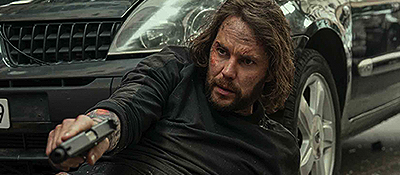
DEADLINE – Prison siege thriller Eleven Days is set to launch for sales at next month’s European Film Market, marking the first feature from newly formed sales firm, Lucky Number 8 Media, a joint venture between Texas-based producer Lucky Number 8 Productions and Daniel Diamond’s Luminosity Pictures.
The new entity will handle international sales on this and Lucky Number 8’s future projects.
Based on the book 11 Days in Hell by William T Harper, the film tells the true story of “one of the most harrowing prison sieges in American history. Taylor Kitsch stars as Jim Estelle, a newly installed head of the Texas Department of Corrections, who is thrust into a life-or-death standoff at the State Penitentiary in Huntsville when a notorious narco kingpin, Federico Carrasco (Diego Luna, Andor), ignites a hostage crisis as part of a meticulously planned escape. Estelle is forced into relentless negotiations to save the lives of inmates and prison personnel including the prison’s priest (Jason Isaacs, The White Lotus) and librarian (Rhea Seehorn, Pluribus).
The ensemble also includes Jennifer Carpenter, Jeffrey Donovan, Lola Kirke, Tenoch Huerta, John Gallagher Jr and Richard Cabral.
The film, currently in post-production, was developed and produced by Vincent Newman (We’re The Millers) and Lucky Number Eight’s Vance Howard. Peter Landesman (Concussion) directed, and co-wrote the screenplay with Kevin Sheridan.
Lucky Number Eight’s slate includes Crossroads, the upcoming rom-com 40 Dates in 40 Nights, and the doc Luv Ya Bum!, which premiered at SXSW.
“Having the opportunity to make this film wasn’t just a filmmaking honor, it became a sacred act” said Landesman. “A suspenseful thriller plot based on a true but little-known story; the actual live prison where this very story took place as our central location; a dream cast that gave us the performances of their careers — these were the elements that make Eleven Days elevated entertainment. It looks like a painting and moves like a freight train”.
“Eleven Days is a ‘truth is stranger than fiction’ story, with universal themes about courage and sacrifice. In telling it, I was determined to honor the people that summoned these rare traits in the face of pure evil. I am very proud of what Peter, Vincent and this incredible cast have delivered,” said Lucky Number 8’s Howard. “I am glad to have Daniel and Luminosity as partners in bringing this film to audiences around the world.”
“This film is nothing short of cinematic brilliance and I am thrilled beyond words to help Vance, Vincent, Peter and all the amazing cast and filmmakers bring it to worldwide audiences”, said Luminosity’s President, Daniel Diamond. “This is only the first in what I hope will many incredible films by our new partnership”
Kitsch is represented by CAA and Untitled Entertainment; Luna is represented by WME; Seehorn is represented by UTA and Untitled Entertainment; and Isaacs is represented by The Gersh Agency and Strand Entertainment. Peter Landesman is represented by CAA and Manage-Ment.
Taylor sat down with Dan and Chris from the Empty Netters Podcast to talk playing juniors in Canada, Friday Night Lights, and The Terminal List: Dark Wolf.
After the notorious box office bomb John Carter, the actor became the movie star who wasn’t. Now back on TV, he’s redefining what it means to be a leading man
There is a moment in every actor’s career when they must confront their early dreams and their present reality. For Taylor Kitsch, that reckoning has been more painful than for most. “If you start marrying yourself to these phantom outcomes that don’t exist, man, you’re gonna go crazy,” he says.Kitsch is talking from New York, thousands of miles from his home in Montana, where he has carved out a different life from his Hollywood years. “I’d rather be in the wild chasing animals with my camera than going to clubs or bars or Hollywood parties,” he says.
Today he’s at a press junket for his new Prime Video series, The Terminal List: Dark Wolf, which expertly marries gun battles and spy intrigue with a neat consideration of what happens when red-blooded American males are confronted by the realities of war. Before our interview, I was excited to see the exact state of dishevelment that the wildlife-chasing actor would greet me in, but my request for him to turn on his camera is politely rebuffed and I have to make do with listening to his disembodied Canadian-cum-Texan boom.
The path seemed so clear in 2012. Kitsch was a 30-year-old Canadian hockey player turned model turned actor, blessed with the kind of looks that make casting directors reach for their phones and studio heads reach for their chequebooks. He had spent the back half of his 20s playing Tim Riggins, the brooding high-school running back and rebel heart of the critically acclaimed show Friday Night Lights. His first forays into movies were solid turns, among them Gambit in X-Men Origins: Wolverine and the photojournalist Kevin Carter in The Bang Bang Club. Stardom seemed inevitable. A few years earlier he had lived in his car on futile visits to LA – now he was looking up at billboards of himself. The Guardian proclaimed him a star “about to turn supernova”.
Then came the big swing: John Carter, Disney’s $264m bet on Kitsch becoming the next great action star. The film was based on the 1912 novel A Princess of Mars, inspiration for a number of great 20th-century space operas (not least Star Wars and Dune) and was meant to be Disney’s answer to Avatar. Hopes were high but the box office gods were ungiving. John Carter quickly became a punchline due to its lackluster title and marketing campaign, which one Disney executive deemed “the worst in the history of movies”. The film itself is decent, certainly better than its 52% score on Rotten Tomatoes, and Kitsch received praise for the “slyness” brought to the title character.
Still, John Carter felt derivative. Its similarities to Avatar in particular (Earth soldier is transported to an exotic planet and begrudgingly accepted by the native population before saving the day) made it a magnet for unhelpful headlines as the early box office returns proved disappointing. It went on to flop so badly (reported loss: $200m) that its title now refers less to the film than its accompanying cautionary tale of big-budget disaster. Meanwhile, the prevailing narrative around Kitsch was that he couldn’t carry a blockbuster – a suspicion compounded by his next film, Battleship, a failed attempt to turn the board game into a Transformers-style franchise that is now primarily remembered for being Rihanna’s film debut.
The cruel irony is that while Kitsch’s charismatic screen presence was honed on a naturalistic high-school drama, his potential big break came in that post-Avatar moment when movie studios looked to build franchises around groundbreaking special effects, without necessarily marrying them to strong characters or coherent narratives.
Kitsch is sanguine about his part in the John Carter debacle. “There’s so many cogs in that wheel of movies, man. I’m literally such a small part of it.” The machine was so much bigger than any one person: “I don’t know if it’s timing, or a million cooks in the kitchen, or it just didn’t hit.” At the time, he took it personally, feeling the weight of a $264m production, the studio’s faith, the expectations that came with being positioned as the next big star. “Over time,” he pauses, choosing his words carefully, “you gave it the best you could. I’m proud of the way I led that shoot. You move on.”
Perhaps the most telling aspect of Kitsch’s story isn’t the fall – it’s what he did while he was down. Rather than chase another potential blockbuster or reinvent himself as a different kind of leading man, he disappeared into the work itself. The roles that followed show an actor no longer interested in being anyone’s idea of a Hollywood heart-throb. In 2015, Kitsch played a repressed highway patrol officer in season two of True Detective, a role that laid the foundation for his subsequent TV revival, embodying wounded men in a country that’s constantly redefining masculinity. He marks out his 2018 part as the cult leader David Koresh in the Paramount miniseries Waco as “a big turn in my career, in the sense of preparation and understanding and not judging a character”. The role of Koresh, a real-life figure responsible for alleged sexual abuse and the deaths of dozens, is certainly more complex than the parts that made Kitsch famous.
“My job is to marry myself emotionally to the circumstances and these guys,” he says. “I don’t think: ‘I hope you like Dave at this point or I hope you hate him now.’ I just want to be as authentic as I can be to him and service that without judgment.” It’s an approach that would prove essential when Netflix’s Painkiller came along in 2023, a limited series examining the opioid crisis through the lens of pharmaceutical executives, addicts and the families caught between them.
For Kitsch, the project was deeply personal. “Addiction runs through my family pretty hard,” he says. “It’s really changed my perspective in a lot of ways.” His sister is in recovery, so when the opportunity arose to play an opioid-addicted salesman, he asked her to advise on the role. “I’ve seen her detox on the floor of my house,” he says quietly. “Those scenes were very close to me and I had more people reach out than any other show I’ve ever done, which meant a lot to me … to share it with my sister was amazing, to be honest.”
Earlier this year, in honour of his sister’s successful journey to sobriety, he founded the nonprofit Howlers Ridge. The organisation provides support for veterans and trauma survivors and represents the kind of purpose-driven project that would have been impossible during his blockbuster years. “I think I’ve grown up a little bit,” he says. “In my 20s, I would see people who’d be like: Well, why aren’t you doing more? You have the means to help people.”
There is an interesting parallel between Kitsch’s career and the characters he is drawn to playing. Many of them are men trying to figure out how to live with themselves, how to carry on when the world has shifted beneath their feet. The transition from movie star to television actor might seem like a step backward to some, but for Kitsch, it represented something more valuable: creative control and the chance to truly inhabit his characters and allow part of them to inhabit him.
The Terminal List: Dark Wolf represents yet another step in his journey back to mainstream attention. Despite a lukewarm critical reception for the original series – including one star from the Guardian – the show became one of Prime Video’s biggest streaming hits ever, largely off the back of a charismatic turn from Chris Pratt in the lead role. Working with Pratt as both co-star and producer for this new prequel series, Kitsch found himself in the curious position of partnering with someone whose career has taken the path his own could have, had the machine worked as intended. Far from any bitterness about Pratt’s fame, there’s genuine enthusiasm in Kitsch’s voice when discussing their collaboration. “We get along really well. I think there’s a mutual respect.” Faced with that level of celebrity, Kitsch thinks about the practicalities: “You often wonder where you’d even be living. I bet you I wouldn’t even be living in Montana.”
The beauty of Kitsch’s current life – photographing wildlife in Montana between carefully chosen projects – is how little it resembles what anyone expected his career to look like. The actor’s career is quieter but perhaps more sustainable. He’s not the action star Hollywood tried to make him, but he’s also not the cautionary tale they might have written him off as. Instead, he’s something more interesting: an actor who faced failure, and subsequently redefined success on his own terms.
“I just want to keep disappearing,” he says, almost as a throwaway. Not from the world, but into roles. Into people he hasn’t met yet, lives he hasn’t lived. Looking at Kitsch’s career now, it’s hard not to think that maybe the supernova metaphor was wrong from the beginning. Supernovae burn bright and burn out. What Kitsch has built instead is more like a campfire: sustainable, warm and capable of lasting through the night.
The Terminal List: Dark Wolf is on Prime Video from 27 August.
Promoting of The Terminal List: Dark Wolf is in full swing. While in New York this week, Taylor not only stopped by The Today Show, but also the SiriusXM studios before the premiere of the series. Photos have been added into the photo gallery.
I have also added screen captures from the fourth season of Friday Night Lights, missing episode stills from the final two seasons and sprinkled in a few higher quality stills and promotional photos from each season as well.


Gallery Links:
Friday Night Lights
Public Appearances > 2025 > August 4: SiriusXM Visit
Public Appearances > 2025 > August 4: “The Terminal List: Dark Wolf” New York Premiere
Taylor visited the Today Show to promote The Terminal List: Dark Wolf.
The series hits Prime Video on August 27th.
Taylor Kitsch (Lone Survivor) is set to star in Eleven Days, an indie hostage pic from filmmaker Peter Landesman (Parkland, Concussion) that’ll shoot in Texas in September.
The film is set in the sweltering heat of a Texas summer in 1974, as head of the Texas Department of Corrections Jim Estelle (Kitsch) plays a deadly game against the ruthless Federico Carrasco, a convicted heroin dealer who has taken over the Huntsville Penitentiary and is holding dozens hostage after his pre-planned escape has gone awry. Lines between captor and captive, justice and survival, begin to blur as the siege spirals for 11 endless, terrifying days.
Based on the book Eleven Days in Hell: The 1974 Carrasco Prison Siege at Huntsville, Texas by William T. Harper, the film was written by Kevin Sheridan with revisions by Landesman. Vincent Newman and Vance Howard will produce.
Kitsch is gearing up for Prime Video’s August 28 release of The Terminal List prequel series, Dark Wolf, a spinoff of the original that explores the life of his character Ben Edwards. He recently starred in back-to-back hit Netflix limited series American Primeval and Painkiller, both of which reached #1 on the Global Top 10 list at the time of release. The latter earned him a Critics Choice Award nomination for Best Supporting Actor. Notable film credits for the actor include Only the Brave, The Normal Heart, Savages, Battleship, and X-Men Origins: Wolverine, to name just a few. He is repped by Untitled Entertainment and WME.
For Landesman, prior feature credits include Concussion starring Will Smith, Parkland starring Zac Efron, and Mark Felt: The Man Who Brought Down the White House, starring Liam Neeson. He is repped by CAA, Manage-ment, and Jackoway Austen Tyerman.
Sheridan is repped by Bellevue, WME, and Jackoway Austen Tyerman.